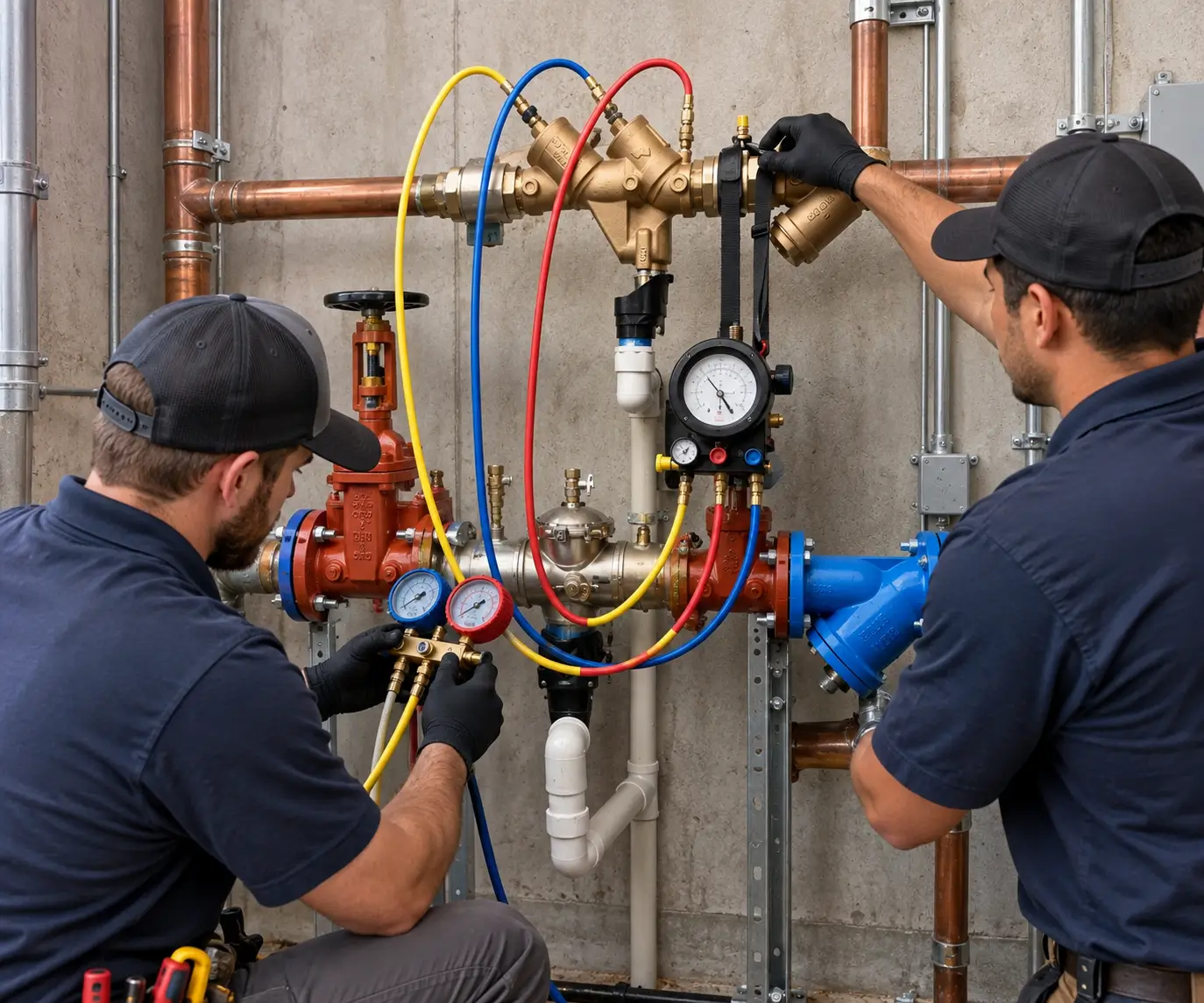
A backflow preventer is designed to allow water to move in the intended direction while preventing reverse flow that could potentially introduce contaminants into the public water supply. Our backflow services include:
- Backflow Testing – Field testing to verify that the assembly is functioning properly.
- Testing Backflow Preventers – Testing applicable assemblies using appropriate procedures and equipment.
- Backflow Inspection – Checking the assembly’s condition, accessibility, installation, and visible components.
- Backflow Preventer Repair – Diagnosing and repairing applicable assemblies that fail testing.
- Backflow Preventer Replacement – Replacing damaged, obsolete, or non-repairable assemblies when necessary.
- Retesting – Testing repaired or replaced assemblies to verify proper operation.
If you’re searching for backflow testing near me, contact Sequoia Plumbing & Mechanical for professional service throughout the San Francisco Bay Area.
What Is Backflow Testing?
Backflow occurs when water or other substances flow in the opposite direction from their intended path. This can create a risk of contaminants entering a potable water distribution system through a cross-connection. A backflow prevention assembly is installed to help prevent this reverse flow. During backflow testing, a qualified tester evaluates the assembly to determine whether its internal components are operating correctly and providing the required protection.
Regular testing is important because a backflow preventer can appear normal from the outside while internal check valves, relief valves, seals, springs, or other components are no longer performing properly.
California Backflow Testing Requirements
California has specific requirements governing cross-connection control and backflow prevention. An important recent change is that California’s former cross-connection control regulations in Title 17 were repealed and replaced by the State Water Resources Control Board’s Cross-Connection Control Policy Handbook (CCCPH). The CCCPH became effective July 1, 2024, and the State Water Board adopted a revised version on June 17, 2025. Under the current California requirements:
- Backflow prevention assemblies covered by a public water system’s Cross-Connection Control Program must be field tested at least annually. A public water system, the State Water Board, or a local health agency can require more frequent testing for higher-hazard premises or assemblies at increased risk of failure.
- Required assemblies must also be field tested after installation, repair, depressurization for winterizing, or permanent relocation.
- Required field testing must be performed by a certified backflow prevention assembly tester. The current CCCPH requires the applicable tester certification to come from a certifying organization recognized by the State Water Board.
- A newly installed backflow prevention assembly must receive a passing field test before continuous water service is provided to the user.
- If an assembly fails its field test, the public water system must ensure it is repaired or replaced within 30 days after notification of failure, although an extension may be permitted if provided for in the water system’s Cross-Connection Control Plan.
- Air-gap separations covered by the program must be visually inspected at least annually.
These are statewide standards for California public water systems. Your local water supplier or health agency may impose additional or more frequent requirements, so property owners should follow the testing notice and instructions issued by their specific water provider.
California State Water Resources Control Board — Cross-Connection Control Policy Handbook
Testing Backflow Preventers
Different plumbing applications can require different types of backflow prevention assemblies. Professional testing backflow preventers requires understanding the specific assembly and the appropriate field-testing procedure. Common testable assemblies include:
Reduced Pressure Principle Assembly (RP)
RP assemblies provide backflow protection using two independently acting check valves with a hydraulically operated relief valve between them.
Double Check Valve Assembly (DC)
A double check assembly uses two independently acting check valves and is used where appropriate for the assessed hazard.
Pressure Vacuum Breaker (PVB)
PVB assemblies are commonly associated with protection against backsiphonage in appropriate applications, including certain irrigation configurations.
Spill-Resistant Vacuum Breaker (SVB)
SVBs provide backsiphonage protection in applicable installations and are designed to reduce water spillage during operation. The correct assembly depends on the application, degree of hazard, and requirements of the applicable public water system.